 Abhishek Dey Roy
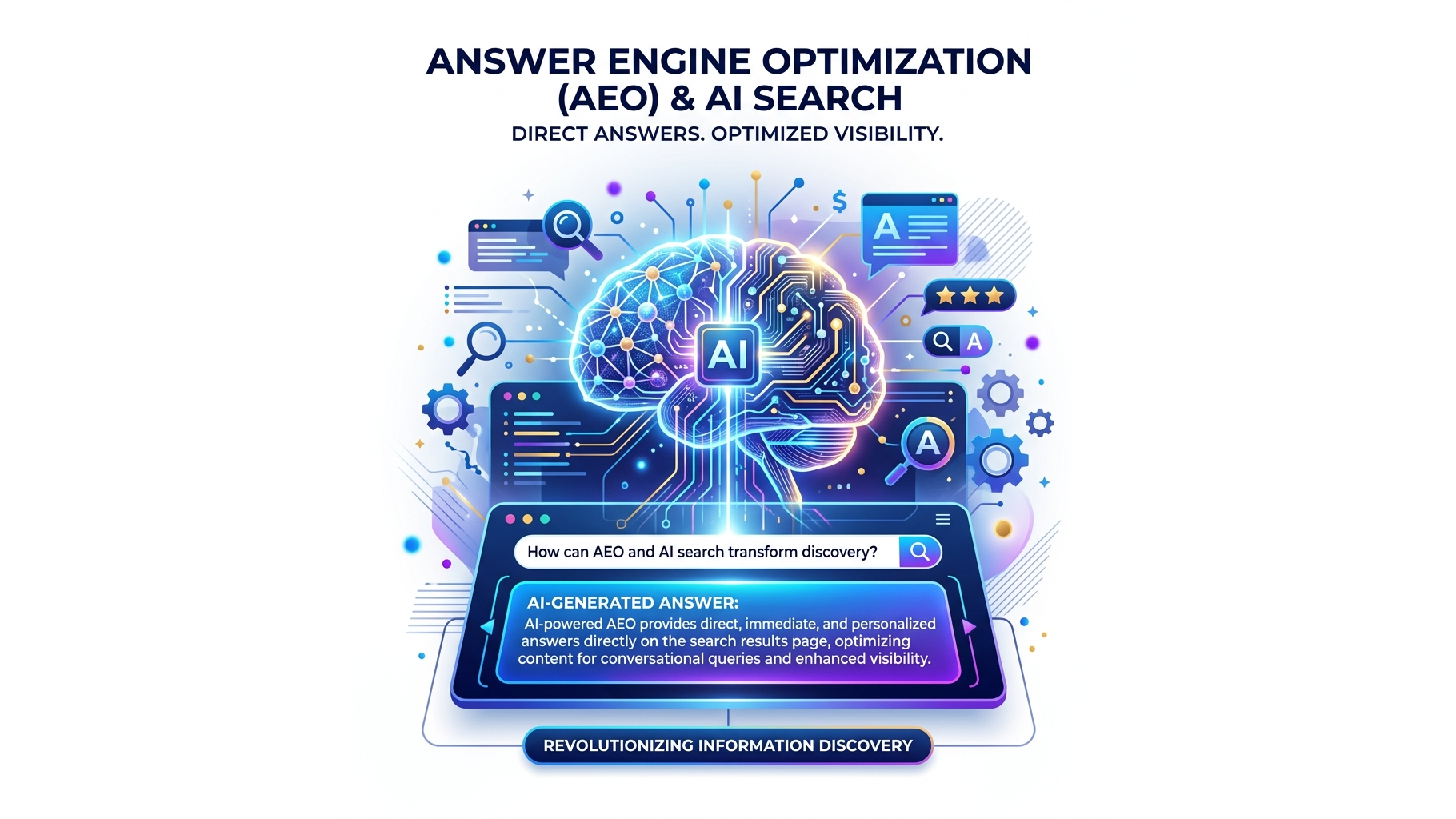
Answer Engine Optimization (AEO) is the process of structuring your content specifically so that AI models like ChatGPT, Perplexity, and Google's AI Overviews can confidently extract and cite it as a direct answer. It relies on extreme clarity, direct formatting, and deep entity relationships rather than traditional keyword density.
Table of Contents
What Is Answer Engine Optimization (AEO)?
Answer Engine Optimization (AEO) is the strategic formatting of digital content to feed artificial intelligence models and generative search engines with clear, unambiguous, and highly structured data. Unlike traditional SEO which optimizes for links to a webpage, AEO optimizes for direct conversational citations within an AI's response.
As search interfaces evolve from providing "10 blue links" to providing direct, synthesized answers, optimizing your content for this extraction process is no longer optional: it is mandatory for top-of-funnel discovery.
Why AEO Matters in 2026
Google's AI Overviews (formerly SGE) and standalone platforms like Perplexity have fundamentally shifted how users search. Users are increasingly asking complex, conversational questions rather than typing fragmented keywords.
When an AI engine synthesizes an answer, it doesn't read your entire website; it parses structured entities, looks for consensus, and extracts concise, factual blocks of text. If your content is buried in long, meandering paragraphs without clear semantic structure, the AI will bypass you for a competitor who provided a clean, direct definition.
How It Works: The Mechanics of AEO
AI engines use Large Language Models (LLMs) combined with Retrieval-Augmented Generation (RAG) to find answers. Here is how you can cater to that exact pipeline:
1. Direct Answer Formats
The single most powerful tactic in AEO is answering a question immediately after asking it. If your heading is an H2 question, the very first sentence underneath it must be the direct, factual answer.
2. Entity Identification and Schema
AI models rely heavily on knowledge graphs. Using explicit JSON-LD Schema Markup (such as FAQPage, Person, Organization, and SoftwareApplication) spoon-feeds the exact definitions of the entities on your page directly to the AI crawler.
3. Table and List Extraction
LLMs are mathematical models that excel at parsing tabular data and bulleted lists. Hardcoding data into clean HTML <table> structures drastically increases the likelihood that an AI Overview will lift your table verbatim to compare products or concepts.
AEO vs SEO: The Real Difference
While AEO and SEO overlap, their goals and required tactics are distinctly different. Here is the breakdown:
| Feature | Traditional SEO | AEO (Answer Engine Optimization) |
|---|---|---|
| Primary Goal | Drive clicks to a website URL | Secure brand citations within AI answers |
| Keyword Focus | Short-tail and exact match keywords | Conversational queries and natural language questions |
| Content Format | Long-form, comprehensive articles | Concise, direct answers and structured data |
| Technical Priority | Backlinks and Page Speed | Schema Markup and Entity Relationships |
Practical Steps to Implement AEO
Transitioning your content strategy to accommodate AEO doesn't require deleting your old posts. Instead, it requires structural refactoring:
- Add a TL;DR Block: Place a 50-word summary at the top of every guide that directly answers the main search intent.
- Implement FAQ Schema: Add 3 to 5 highly specific questions to the bottom of your articles, marked up with valid JSON-LD FAQ schema.
- Remove Fluff: Delete "introductory fluff." Do not start an article with "In today's fast-paced digital world..." Start immediately with facts.
Frequently Asked Questions
Is AEO replacing SEO?
No, AEO is not replacing SEO; it is an evolution of it. While AEO optimizes for AI-generated answers and voice search, traditional SEO still governs the underlying ranking architecture and organic discovery of the source URLs.
How do I optimize for Google AI Overviews?
Optimize for Google AI Overviews by structuring content with clear H2/H3 hierarchies, providing concise 40-50 word direct answers immediately following headings, and backing up claims with robust entity schema markup.
What is the best schema markup for AEO?
The best schema markup types for AEO are FAQPage, Article, QAPage, and explicit Entity markup (like Person or Organization) because they provide the exact structural data that Retrieval-Augmented Generation models parse.
How long should an AEO answer be?
An optimal AEO answer should be between 40 and 50 words. It must stand entirely on its own, delivering a complete, factual response without relying on surrounding paragraphs for context.
Does Perplexity use SEO rankings?
Perplexity relies on both traditional SEO trust signals (like domain authority) to find credible sources, and AEO signals (like clean formatting and direct answers) to actually extract and synthesize the text for the user.
Your feedback helps us improve our content for everyone.
