 Abhishek Dey Roy
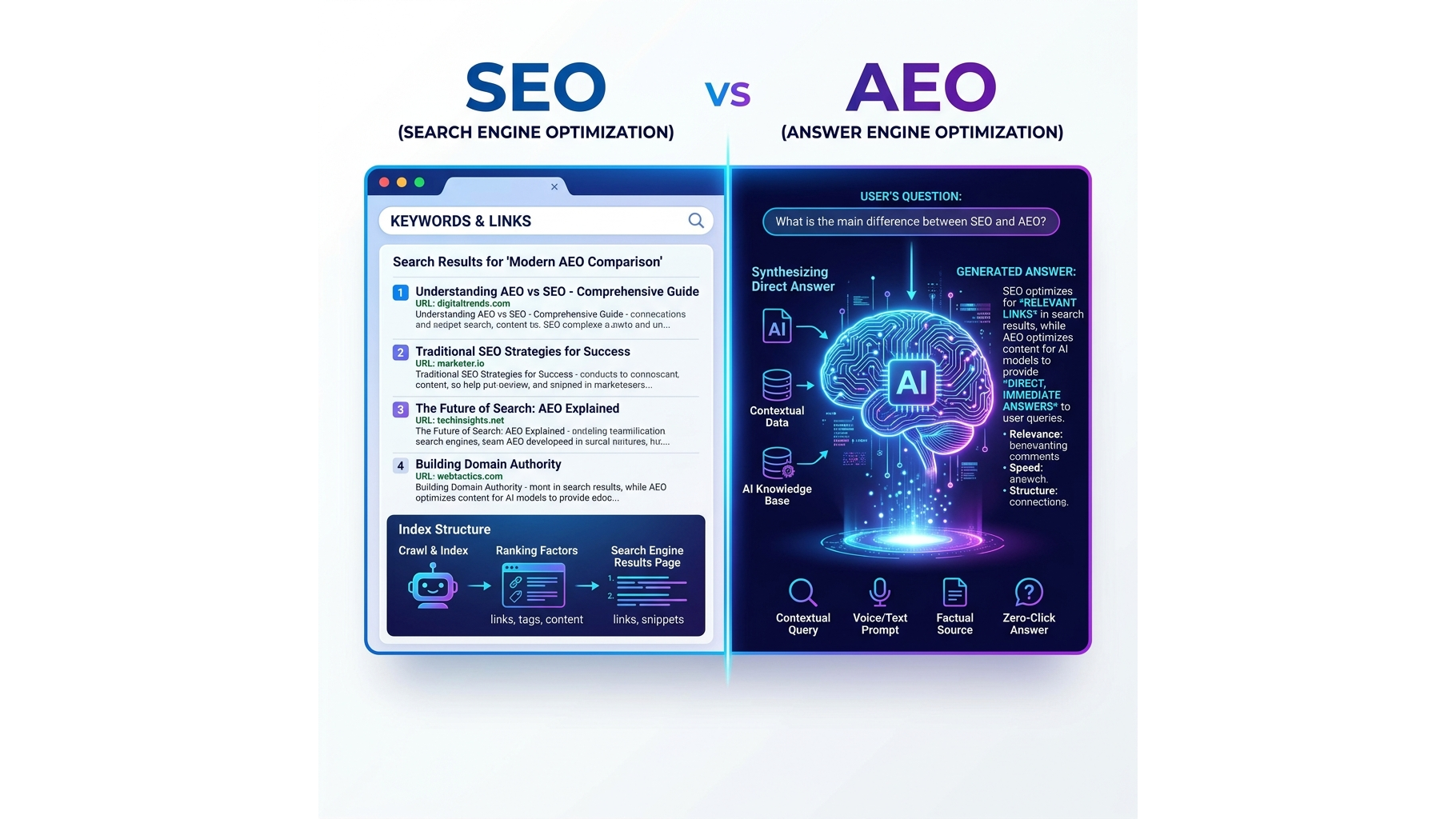
Traditional SEO optimizes pages to rank in search indexes based on keywords and links, whereas AEO (Answer Engine Optimization) structures factual data so AI models can synthesize and cite it directly. To succeed in 2026, you must employ SEO for discoverability and AEO for extraction.
Table of Contents
What Is the Difference Between AEO and SEO?
The difference between AEO and SEO is that SEO focuses on driving traffic to a destination URL via keyword relevance, while AEO focuses on formatting specific facts so an AI model can extract them to answer a user's question immediately.
For decades, SEO was a zero-sum game: you either ranked in the top 10 blue links, or you didn't. With the advent of generative search, the paradigm has shifted. Users no longer want a list of links; they want synthesized answers.
Why It Matters
If you treat AI Overviews as just another SEO feature snippet, you will lose organic visibility. Many legacy SEO strategies (such as long-winded "recipes" before getting to the point, or burying answers inside dense paragraphs) are actively hostile to AI extraction.
You can no longer rely solely on high Domain Authority to save poorly formatted content. A lower-authority site that provides a clean, schema-backed, 40-word direct answer will frequently bypass a massive publication when an AI synthesizes a response.
How It Works: Combining Both Strategies
A common misconception is that AEO replaces SEO. This is fundamentally untrue. Retrieval-Augmented Generation (RAG) models, like those powering Google AI Overviews, still rely on traditional search indexes to find trustworthy source documents.
1. The SEO Foundation
Before an AI can extract your answer, it must discover your page. Traditional SEO handles the crawling, indexing, page speed, and backlink authority required to put your document into the candidate pool.
2. The AEO Extraction
Once the AI retrieves your page, AEO takes over. The AI ignores your backlinks and instead scans for clear semantic structures: H2 headings that match the user's query, JSON-LD entity definitions, and concise, factual paragraphs.
The Ultimate Comparison: AEO vs SEO
To fully grasp the strategic shift, we must look at how each discipline approaches the same optimization dimensions.
| Optimization Dimension | Traditional SEO | AEO (Answer Engine Optimization) |
|---|---|---|
| Core Objective | Drive user clicks to a webpage | Provide direct, synthed answers and earn citations |
| Keyword Strategy | Exact match and broad match targeting | Conversational queries and natural language NLP |
| Content Format | Long-form content, keyword-rich headings | Direct answers (40-50 words), structured data tables |
| Success Metric | Organic Traffic and Keyword Rankings | Brand Mentions and AI Overview Citations |
| Technical Focus | Page Speed, Core Web Vitals, Crawlability | Schema Markup, Knowledge Graph, Entity Clarity |
Practical Steps to Bridge the Gap
If you already have a strong SEO foundation, you are 80% of the way there. Here is how to cross the finish line:
- Audit Top Content: Identify the pages driving the most traffic. Add a TL;DR block to the absolute top of the page that answers the core query immediately.
- Convert Lists to Tables: If you are comparing multiple items using bullet points or H3s, convert that data into an HTML table.
- Inject Entity Schema: Go beyond basic Article schema. Use
AboutPage,FAQPage, andProductschemas to map exact entities.
Common Mistakes in the Transition
The most dangerous mistake is abandoning traditional SEO entirely. Do not ignore your site architecture, internal linking, or page speed in favor of writing AI answers. If Google cannot crawl your site efficiently, AEO formatting will not save you.
Frequently Asked Questions
What is the main difference between AEO and SEO?
SEO focuses on optimizing web pages to rank highly in search engine results for specific keywords, while AEO focuses on formatting facts so AI models can extract and synthesize them into direct answers.
Should I focus on AEO or SEO?
You must focus on both. SEO provides the baseline trust and discoverability required for indexing, while AEO ensures your content is actually chosen and cited when AI generates a specific answer.
Does AEO require new content?
No, AEO rarely requires entirely new content. It usually involves refactoring existing content to include direct answers, clear heading hierarchies, and explicit JSON-LD schema markup.
Can a page rank in SEO but fail in AEO?
Yes, a page with high domain authority can rank #1 in traditional SEO but be ignored by AI Overviews if its answers are buried in long, unstructured paragraphs lacking clear entity definitions.
How do AI engines find AEO content?
AI engines use Retrieval-Augmented Generation to search the traditional index for relevant documents, then parse those documents looking for the most concise, mathematically consensus-aligned factual statements to extract.
Your feedback helps us improve our content for everyone.
